
Productization: five degrees, and how far a firm should go
A packaged workshop and a spun-out software product both get called productization. They solve different problems.
 by Phil Lieng
Over the past few months, I’ve had a lot of conversations about productization with people who run agencies and professional services firms.
AI made it easy to automate workflows and build internal tools. I see media agencies building in-house analytics and planning tools, law firms automating tedious clerical work, and consulting firms gathering past case studies into knowledge bases to back their recommendations.
That pushed many of them to a bigger question: should we sell this? For a service business, the idea of adding a recurring revenue stream is appealing.
That got me reading. I went back to the classics on how service firms make money (David Maister’s split between brains, grey hair and procedure work), how know-how becomes a repeatable method (Roger Martin’s knowledge funnel), why a firm that runs without its owner is worth more (John Warrillow’s Built to Sell), and the Nordic research that defined productization for services.
Most of the models I found describe productization as a ladder you’re supposed to climb. I find it more useful to think of it in degrees. Each degree solves a different problem, and most firms only need to go one degree further than where they are today.
Five degrees of productization
Productization means packaging what a service firm does so clients can understand it and buy it more easily, and so the firm can deliver it the same way every time. There are degrees to it. Each one solves a different problem, and a firm can stop at any of them. Most firms start at zero.
| Degree | What changes | What it solves |
|---|---|---|
| 0. Services (starting point) | Services listed by discipline | Clients see what the firm does |
| 1. Named offer | Offers built around a client’s problem or goal | Clients see which offer fits their situation |
| 2. Packaged and priced | Fixed scope and fixed price | No custom scope or proposal for each deal |
| 3. Internal product | The method lives in a tool the team uses to deliver | Quality doesn’t depend on specific people |
| 4. Standalone product | A product with its own customers, sales and marketing | It sells without the service business |
0. Services
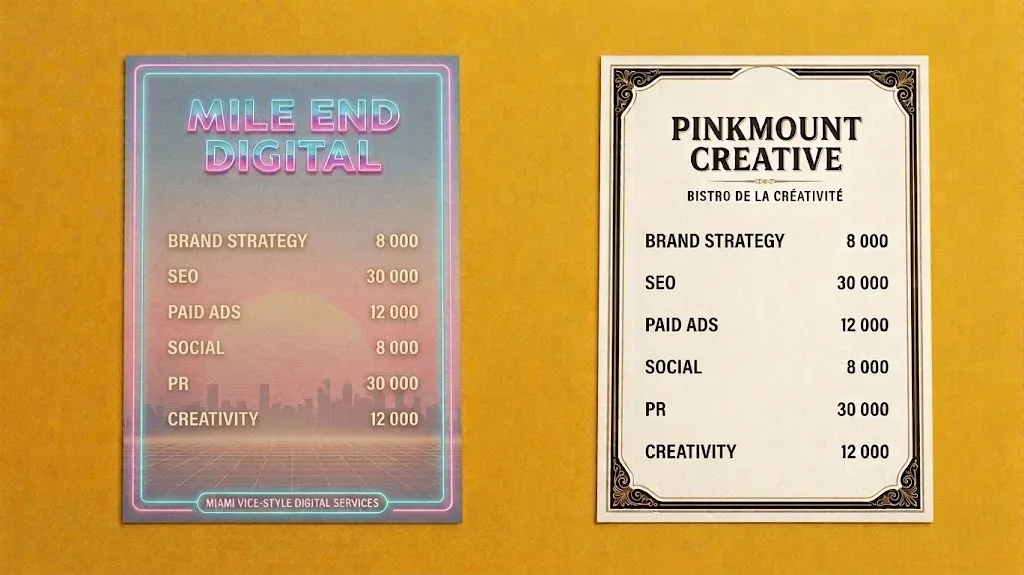
Go to most agency, management consulting or law firm websites and you’ll find a list of services: brand strategy, SEO, content. Or corporate, litigation, real estate. It’s better than “we do a bit of everything,” because at least the buyer learns what a generalist firm can do. But it reads like the features list on a software page. It describes the firm by discipline and leaves the buyer to work out which parts fit their situation.
A regional economic development organization I worked with had this problem. It offered expertise in digital transformation, sustainable development and HR consulting, and so did the banks and consulting firms it competed with. On paper, the services looked the same. When we looked closer, a big share of its help in each area came down to a few recurring themes, like ERP implementations or carbon tax credits.
The first degree of productization fixes that. I wrote about the marketing agency version of this in What can marketing agencies learn from tech?
1. Named offer
Instead of listing what the firm can do, a named offer starts from a problem the client has and says how the firm solves it. The work itself doesn’t change. The client just recognizes their problem without needing a call to figure it out.
At the economic development organization, we rebuilt the offer around those recurring themes. The old services described capabilities. The new ones were solutions built around a theme, like an ERP implementation or carbon tax credits. That made them much easier to market, and easier to tie to an outcome a business owner cares about.
The firm still scopes and prices each engagement from scratch, though.
Adviso, a Montreal digital marketing firm, does something similar on its website: next to its list of services, it organizes its offer around client goals like growth and profitability.
Right for you if you can answer yes:
Can we name the few problems most of our clients come to us with?
2. Packaged and priced
Most service firms bill by the hour or write a custom proposal for each client. A packaged offer has a fixed scope and a fixed price, set in advance. The client knows what they get and what it costs before the first meeting, and the firm stops writing new proposal details from scratch for every deal.
A leading Canadian recruitment firm I work with charges a flat rate for its sourcing mandates, its core expertise. Over the years it built and refined a method rigorous enough that new recruiters go through onboarding to relearn how to do the job. The flat rate guarantees a healthy margin for the firm.
That last part matters. If the firm delivers faster thanks to optimized processes and expertise, it keeps the gain.
Pro tip
A flat price only protects your margin if the way you deliver is predictable. Fix the method before you fix the price.
When an engagement ends, though, the firm still has to sell the next one.
Right for you if you can answer yes:
Can we deliver this the same way for most clients?
3. Internal product
Here the firm builds its method into a tool its team uses to deliver the work. It’s a real product, but an internal one: the firm doesn’t sell it on its own. The work stays just as good when people leave.
The recruitment firm from degree 2 does this too. Its method lives in a process every recruiter learns, and in a dashboard built around the firm’s own workflows. Recruiters and clients both use it, and clients get more transparency and market intelligence. The firm chose not to sell the dashboard on its own. Commercializing it would have pulled the firm away from what it actually sells: recruitment expertise and judgment. Building the tool around its own workflows made its services more valuable instead. At the end of the day, recruitment is about people.
Tools cost money to build, and someone has to keep them up to date, even if only your own team uses them. New hires also have to learn the method, which takes time.
Huge shows what this looks like at a large agency. It describes its approach as an in-house operating system that connects its people, AI agents and knowledge, run by small expert teams.
Right for you if you can answer yes:
Can we write down how we do this well enough to build a tool around it?
4. Standalone product
The tool becomes a product the firm sells on its own, with its own customers and its own sales and marketing, and sometimes its own team, P&L or company. It no longer needs the service business to sell it.
A Canadian digital marketing agency I worked with had built a marketing measurement tool for its client work and wanted to sell it on its own. Within three months of launch, it had around a dozen paying customers, including one large, well-known brand.
At this degree, you’re running a different business. That’s where most service firms get surprised.
Right for you if you can answer yes:
Can we sell, support and keep improving this as a product?
Selling a product means running one
A Canadian law firm I worked with built a platform for construction SMBs. It started as a side project. To build it and sell it beyond the firm’s own clients, the partners hired a dev shop, UX designers, marketing agencies and consultants.
Service firms that have never run a software product tend to underestimate the work it takes to build and support one. To fully support a product, you need:
- People in support or account management who can troubleshoot for customers
- Technical people to fix it and keep it up to date
- Someone who owns the roadmap
- Sales and marketing that look nothing like selling services
An agency group I spoke with this year is going through this right now. It built AI tools for its own teams and is deciding whether to sell them as products or use them to win custom projects.
Selling is different too. The marketing agency from degree 4 first wanted to sell its tool to anyone, the way it sold its services. We picked one segment to start with and launched the tool through clients who already trusted the agency.
Another route: the managed service
A managed service doesn’t package the work. It changes how the firm puts its people to work. Instead of hiring the firm project by project, the client pays a monthly fee and hands over a whole function or an ongoing job to a dedicated team. The client no longer has to manage that work, and the firm no longer has to find new revenue every time a project ends.
For over a year, I led sales and marketing part-time for an event venue marketplace. One venue asked us to take over its bookings and customer service entirely, for a flat monthly fee. We wrote down how we ran that first venue and turned it into a service for other venues. Two signed.
The trade-off is cost and risk. You pay for a dedicated team before the revenue comes in, and a team built around one client depends on keeping that client.
Advertising holding companies sometimes create business units dedicated to serving big clients:
- Omnicom created We Are Unlimited for McDonald’s in 2016 and folded it back into the group three years later.
- WPP put together Theo for Rogers in 2020, with people from Taxi, John St. and Mindshare.
Right for you if you can answer yes:
Can we run this for clients month after month, with a team dedicated to it?
The biggest mistake when you productize
Most firms put their effort into building the offer: the name, the scope, the price, the web page. Then they keep selling and marketing it the way they always have, instead of adapting their go-to-market strategy. Salespeople fall back on custom proposals, and the website still describes the firm by discipline. If the way you sell and market doesn’t change, clients see the new offer as the same old services.
Pro tip
Before you launch an offer, decide who will sell it and how.
How far should you take productization?
Look at where your firm is today and what’s holding it back, then go one degree further. For most firms, that’s enough. If you’d like help figuring out which degree fits, that’s the kind of service productization work I do.
FAQ
What is a productized service?
A service with a defined scope, a set price and a repeatable way of delivering it. In the degrees above, that’s degree 2.
Does productizing mean lower prices?
No. The price follows the scope, not the hours. If you deliver faster and keep the same price, you keep the margin.
Should every service be productized?
No. Custom, high-judgment work is often what makes a firm worth hiring. Package the work you repeat and clients value, and protect the rest. I cover how to sort it in What can marketing agencies learn from tech?
Sources
- Adweek, “McDonald’s and Omnicom Launch New Dedicated Agency” (November 2016)
- Business Insider, “The ad agency Omnicom created to service McDonald’s will soon fold” (September 2019)
- Strategy, “Rogers integrates creative and media work with WPP” (June 2020)
 8 min read
What can marketing agencies learn from tech?
Read three agency services pages and you have read the same page with a different logo on it.
Read